
I have read that only 1% of veterinary graduates are entering equine medicine, and 50% of them will switch to small animal practice or some other field within 5 years. There are a host of things contributing to this. Incredible school debt, low salaries in equine practice, harsher working conditions, the requirement to be on-call after hours, the attitudes of clients towards younger veterinarians, and several other reasons have been offered for these depressing statistics. At this rate, our profession is facing trouble in the years ahead.
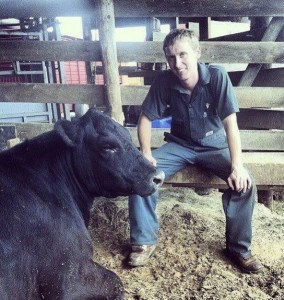
I graduated in 2013 and on a handshake, committed to buy my mentor’s single doctor practice he ran for 19 years in my hometown in Western North Carolina. He and I spent exactly 2 weeks together, and then he moved across the country where his wife had taken a job. For the first time in his 27-year career, he moved into a small animal practice. He is a wonderful human being and veterinarian, but in his own words “wasn’t a businessman”.

What I bought was a phone number, some inventory, a Toyota Prius with 200,000+ miles, a cardboard box with the previous 12 months of carbon-copy coggins results, a box of hand written carbon copy invoices for the previous 12 months, and some basic equipment for large animal practice – an old Sonovet ultrasound with a rectal probe, hand dental floats, obstetrical equipment, etc. There were no set business hours, charges were low, he answered the phone and texts all day and evening and weekend. There were no easily accessible or organized records except the file box, and no client list. He was working as hard as he could to support a large family, leaving no time to do anything but run calls. He was left with a practice that was not marketable. But he was one of those people who was just happy by default. It was remarkable. It worked for him. But I would soon learn, I was not able to run things that way.
My wife and I sat down every night those first couple of weeks to enter client and horse information from coggins results into a database to create a client list. My wife joined me in the truck 3 days a week to help and handled office duties and worked around the house the other two days a week – the woman is a complete Godsend and a saint. Some clients were understandably skeptical of me. I was 25 years old and baby-faced. There was no client list, so we couldn’t do a mass mailer to let everyone know he was leaving. I had him write a letter that I could put on the newly created website and Facebook page to try to get the word out. If they didn’t hear the news from a friend at the feed store or one of their trail riding buddies, they learned it when they called and got a different voice on the voicemail. If I had a dime for each time I had to tell exactly where he went and who I am, I would have quite the savings account. This would continue for 5 years until I finally spoke to everyone living off the grid and who only calls every few years for a disaster calving. I had been around livestock most of my life and had a good deal of know-how with restraint, roping, and the tips and tricks. I also knew the area, how people think and what they value in Appalachia, and how to make small talk. I think that mattered more than my technical skill to many folks – I respected people’s experience, took time to listen and talk about life and current events, while remaining humble.
From the beginning, I made the decision to set regular and emergency hours and slowly adjust pricing to make sense for the time involved. I moved over to digital coggins right away, used Quickbooks initially to start keeping sound financial records and actually used it to log medical records from the on-the-farm, hand-written invoices.. We made the conversion to eVetPractice practice management software after 1 year. We slowly added on some equipment as we got an understanding of cash flow and how the business was performing – Powerfloat (2014), then digital radiograph (2015), then a new ultrasound (2018). We ditched the Prius after 3 months and ran out of a Honda Pilot (2013), eventually moving into a truck with a Bay Horse Body (2016). Year after year we were seeing growth – new clients, increased revenue. We were offering a few more services, particularly on the equine side, and taking time to improve on some preventative care – getting more folks to vaccinate, do fecal egg counts, discuss nutrition, and float teeth.


For the first 18 months, I had no one to rotate call with – our practice area was too large and the neighboring vets I knew already had a rotation and really were not willing to drive the distances – or didn’t want to see cattle, small ruminants, and camelids. Honestly, some of them didn’t care much for the previous practice owner for undercutting price, which I recognized and was trying to fix. So, I worked, and made myself available. After 18 months, a classmate started a practice just east of me and we made the commitment to help each other every other weekend. That leant me 4 days off a month and the occasional night off for anniversaries or special occasions – a huge relief late in 2014. I realized I was burning out – I had no hobbies, was becoming quite short with people and animals, I was constantly feeling slave to the phone. I would choose not to go out to dinner in the next town over, go see a movie, go for a hike, go for a weekend getaway, skip a wedding, skip the niece and nephew’s graduation – all for fear of missing a call. There was enough work for 1.5 vets, and probably 3 vets for a few months out of the year, but relief large animal veterinarians are not really a thing here, and I didn’t feel financially safe enough to bring on help.
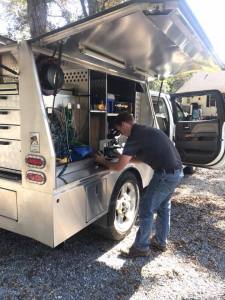
I’ve recently committed to some changes to make this job something that I want to do for a career. On 4/21/2017, I (and my wife) realized my mental health taking a beating and I discussed it with my physician. The doctor calls it an “adjustment disorder” – a “group of symptoms, such as stress, feeling sad or hopeless, and physical symptoms that can occur after you go through a stressful life event. The symptoms occur because you are having a hard time coping. Your reaction is stronger than expected for the type of event that occurred.” And as we realized it persisted beyond the stressor, “dysthymia” – a mood disorder consisting of the same cognitive and physical problems as depression, with less severe but longer-lasting symptoms. I started an anti-depressant. It certainly helped in that my response to daily stressors were more appropriate – I didn’t blow up over relatively minor things or dwell on them. My anxiety felt a bit more controlled. I made time to treat my introverted personality to a walk by the creek, or tell my next appointment I’m running an hour behind so I could just sit on the dam at the lake and breathe a while, or eat lunch. Granted, I think some of it was just time and experience, learning what was really urgent and worth my stress, and when I really need to just be still. I also lacked collegiality and was out here going at it alone, other than checking in with classmates by phone or social media.
Five years post-graduation, year 2018, I met some 5-year goals and made some plans to create a work environment that would be sustainable. I paid off the purchase of the practice and paid off my school loans (school debt was at $125,000). I hired a technician part time to help me on Tuesdays and Thursday when my wife was doing office stuff. The phone is a stressor – I end up spending too much time on the phone for simple things like scheduling and she helped do that while I was driving and avoided me being captured for 15 minutes with questions. Having a set of hands on Tuesday and Thursday enabled me to do more procedures that required 2 people. I started planning for an associate as my personal need for money from the practice had become less with some debt relieved.
I enjoy having students along and have had some stellar folks come along since 2013. I was fortunate to work with a vet student from Georgia for 2 summers. We seemed to share values and she had an interest in our practice, so we were able to come up with an agreement to bring her on board in June 2019. Similarly, the practice with whom we share weekend emergency duty brought on an associate in 2018. This has allowed us to each work 1 weekend a month. My associate and I share weeknight call – 2 nights on call each week. We are also each working 4-day work weeks – I’m off Tuesday, she is off Wednesday. Is this real life? I can walk my dog without a cell phone?
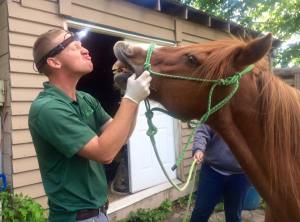 Am I drawing as much money as I did in the first 5 years? Not yet. I’m paying myself a little less. Am I happier? Indescribably better. There’s time to volunteer for things at church, play the piano, pick up mountain biking, and get back on a horse. I can meet a friend for lunch on my day off and mow my grass. Of course I still get overwhelmed and ticked off by the occasional snide client comment, the “that’s not what I saw on Chronicle of the Horse” type, or I have to make someone mad because they got off work early and I’m late having to help a thrashing colic. But it’s the normal kind of stress – the here today, gone tomorrow, this-is-still-veterinary-practice kind of stress. I am better than I once was, and I can currently see the forest and the trees again.
So, what is next? We bought a farm near where I grew up in 2017, about 60 acres. It is spread out enough that we can maintain our private barn, and have space far enough away to maintain a small haul-in facility. Two trucks and a staff of four just doesn’t fit in my garage anymore, and it will give us a space that is not my house – a bit of separation. It will allow us to have clients with smaller patients in the far nooks and crannies of the practice to haul-in after hours and save travel time and their cost. It will let us do a little more – some fluid therapy, breed mares in house instead of making multiple farm calls, keep a bad wound for a few days for continued care, stall a horse that doesn’t have a barn, etc. We’ll have a small animal surgery suite for the pot-bellied pig spays/neuters and the small ruminant case load. Ideally, I aim to have 3 veterinarians within 5 years. Our personal family goal is to be able to build a home at the back of the property in 7 years.
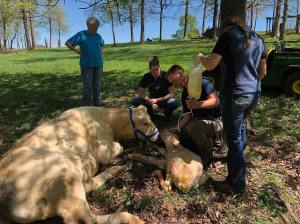
I’m not sure that I would recommend my path to ownership to just anyone else. I was warned not to run my own practice right out of school, and I understand that recommendation now. However, I saw opportunity, it passed my gut-test, and I felt a calling to move home and practice. I did not realize how hard it would be, what it would do to my mind, and the personal decisions I would have to make to stay sane and functional. I also did not realize how I would come to care for my clients, nor how they would care for me in so many ways. I did not realize that I would have students tagging along and falling in the love with the job, even as I was struggling to convince myself that I could do this for an entire career and avoid being put in a straight jacket. But you can ask those students, they have heard my spiel and know about the ugly parts of our job and how it can affect your own wellness. They have seen my smile break in between farm calls. They have seen me get choked up over the loss of a patient. They have seen me console grieving families. They have seen me in moments of weakness. They have seen me being completely human. I like to think that my internal struggles were not in vain, if I can make sure that students understand this job, how to take care of themselves, and maybe encourage other practice owners to ditch the “right of passage” or “comes with the territory” mindset and create a better work culture for themselves and their associates. We know the things that suck the life out of our people, and we should control the controllable.

I love large animal practice. I do not like her every single day, and I nearly fell out of love with her completely. I am realizing that I do have some control in making choices to keep this relationship healthy during the ups and downs. I have sat down with a beer on my back porch many nights feeling utterly hopeless. That sucky, all-four-tires-digging-deeper-into-the-mud kind of stuck. I write the story of my beginning to commiserate with anyone who might be in a similar position and to encourage other practices to prioritize wellness. And if you are sitting there waiting on a tractor and chain to pull you out of the mud, know that I understand, and so do many of your colleagues. You are doing a great job and people appreciate you. I want you to succeed. I want you to feel better. I want you to focus on yourself first so that you might have clarity to set goals. I want you to see the day that you can shake the little stuff and move on. It is totally doable, you were once able to do it, and you can get there again. And once you do, make sure to tell your story, so we can try to make this job a little more desirable for the large animal doctors of tomorrow. And if you have to move over to another sector of veterinary medicine, that is okay, too. You matter and you deserve to do fulfilling work. Be well.


I ended up giving my mobile equine vet a hand with the horses he saw while he was establishing his practice. I quickly decided to teach all of my own horses ( was averaging 25-30 head at the time) to stand quietly and cooperate for exams, dental work, sheath cleanings, rectal temperature etc as well as hoof care. When I was asked to write a series on horses training, I included that ground training in the first volume. Expecting your vet to train your horse at the same time they are treating them is a recipe for disaster! Anyway, here is a link to the book- vets might find it handy for themselves and they can recommend it to their costumers in the hopes of making visit just that little bit easier and safer..
LikeLike