

I had an interesting case this week that we shared on our business page and was surprised to find that it interested a lot of folks and generated some questions. I thought I would share that information here to unload some of the details.
We received a call from our dear friends at one of the few remaining dairies in our practice. To preface – when a dairy farmer calls for help with a calving, you should brace yourself for something interesting. These men and women have seen and done it all, so it takes something peculiar for them to ring the vet for assistance.
The client explained that the cow had been laying down Sunday night and separated from the herd. They did an internal exam and just felt that the calf was deep in the abdomen, thinking that she may need more time. On Monday morning she was streaming milk so they milked her in the parlor, and she went out to a hospital pen and she got up and down 20-30 times, but there was no vaginal discharge or progress towards calving so they gave me a call.
A vaginal exam told the story right away. The cervix was dilated, but the vagina was twisted tightly and forced my arm down and to the left into the uterus to feel an unruptured “sack” and a very active calf. There was a tight band of the broad ligament on the right side of the vagina from the weight of the calf pulling a twisted uterus to the left. A uterine torsion. A veterinarian in a high volume dairy practice likely sees these several times a year, but in our neck of the woods, it is just once every couple of years.
There are a few options for managing these.
- If you are Dr. Hulk, you can stick your arm in and manually rock the calf back and forth until you get enough momentum to flip the calf back over the uterine body. Not I.
- Another option is to apply chains or ropes to the calves legs and use a detorsion rod to twist the calf’s body up and over the uterine torsion.
- A third option is to surgically open the cow’s abdomen through her flank while she is standing, grasp hold of the uterus and flip it.
- Fourth option is to do a cesarean section, opening the uterus surgically and removing the calf.
- A final option is to lay the cow down, put a board on her abdomen, stand on the board to press the fetus/uterus down, and flip the cow over to untwist the uterus. What? Yep. That’s what we did.
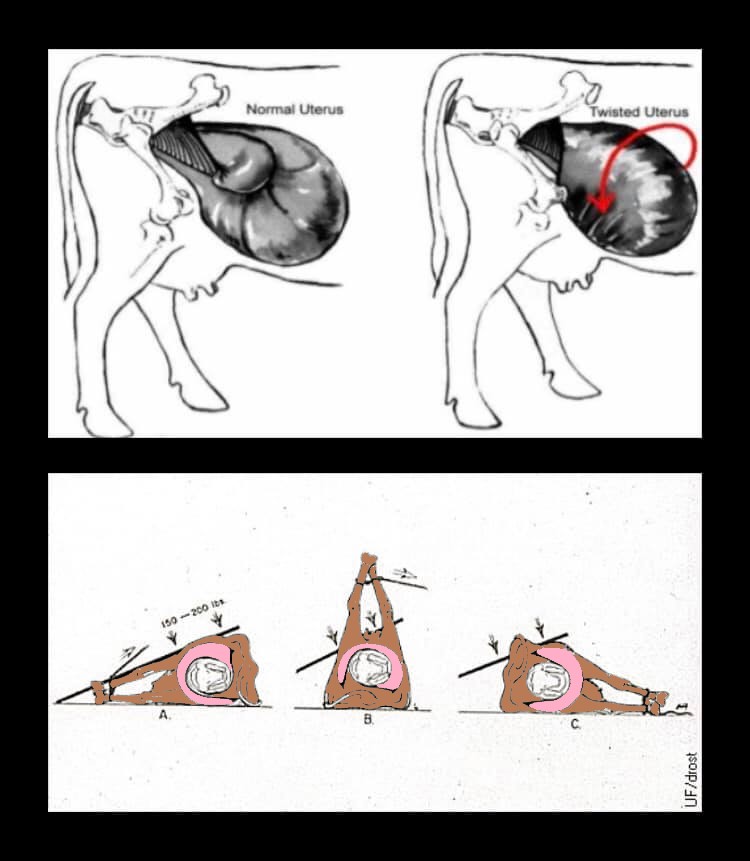
In this case, we were fortunate because the placenta, providing blood supply to the calf, was still attached to the uterine wall and the chorio-allantois nor aminotic sac had ruptured. The cow was not able to contract forcefully enough to get the calf up into the birth canal due to the twist, so she could not generate enough pressure to rupture these membranes that would allow delivery to continue. The calf was mildly stressed, but completely safe – all credit goes to the dairymen who recognized a problem right away.
We gave her a light sedative and put ropes over her to encourage her to lay down. This patient was a left (counterclockwise) torsion, just to opposite of the diagram I’ve shared above. The common question we get is, “how do you know which side to lay her on?” If the uterus is twisted to the cow’s left side (a counterclockwise twist when viewing from the cow’s rear), the cow is laid down on her left side to start the process. A 12-16 ft board is placed behind the cow’s last rib and a 150-200 pounds person stands on the board as assistants use ropes tied to the cows rear feet to rotate her legs up and roll her over to the right side. The pressure of the person on the fetus keeps it in the same orientation and it is the cow who is twisted to catch back up with the correct uterine position. In our case, it took one twist and the calf was easily accessible and the membranes were ruptured. For a counterclockwise torsion, the cow is rotated counterclockwise when viewing from rear and vice-versa.
Uterine torsions are always emergencies and can have very bad outcomes. The pressure of the uterus twisted can cut off blood supply to the fetus or the entire uterus putting the calf and cow’s life at risk. It is recommended that a veterinarian be involved with these. If you misdiagnose the direction of the torsion or flip the cow incorrectly, you can tighten the twist and lead to disaster. The cow should be flipped once and a repeat vaginal exam performed to see if the problem is fixed. The flip can be repeated (roll the cow over without a board, reapply the board and flip again). If one is lucky when they do it incorrectly, you can twist the cow back the opposite direction under plank pressure twice to fix it. You want the vet there for these.
Enjoy the sights and sounds of this strong bull calf and his proud dam moments after delivery.
 windshieldrambling.com